
Before signing with any wedding vendor, you should ask who specifically will be at your event, what happens if that person is unavailable, what your cancellation rights look like on both sides, and whether anyone on your vendor team has a financial relationship with the others. Most couples don't ask these questions. Many vendors are counting on that.
This post is written from an entertainment company's perspective. I started St. Royal in Toronto in 2011, and we've been ramping up across LA, Chicago, and Miami since 2023. The sections on live music, bands, DJs, and AV coordination are where I can speak with the most authority -- it's what we do every day. For other vendor categories -- planners, venues, photographers -- we work alongside these professionals constantly, and I know the questions worth asking. We'll keep those sections tighter and let entertainment take the depth it deserves.
Here are the questions that matter, organized by vendor type.
The most important questions to ask a wedding band, DJ, or entertainment company are: who exactly will be performing at your event, what happens if that performer is unavailable, how they handle AV coordination with your venue, what their music planning process looks like, and what could change the final price. Each of these is covered in detail below.
This question tells you more about how an entertainment company operates than almost anything else.
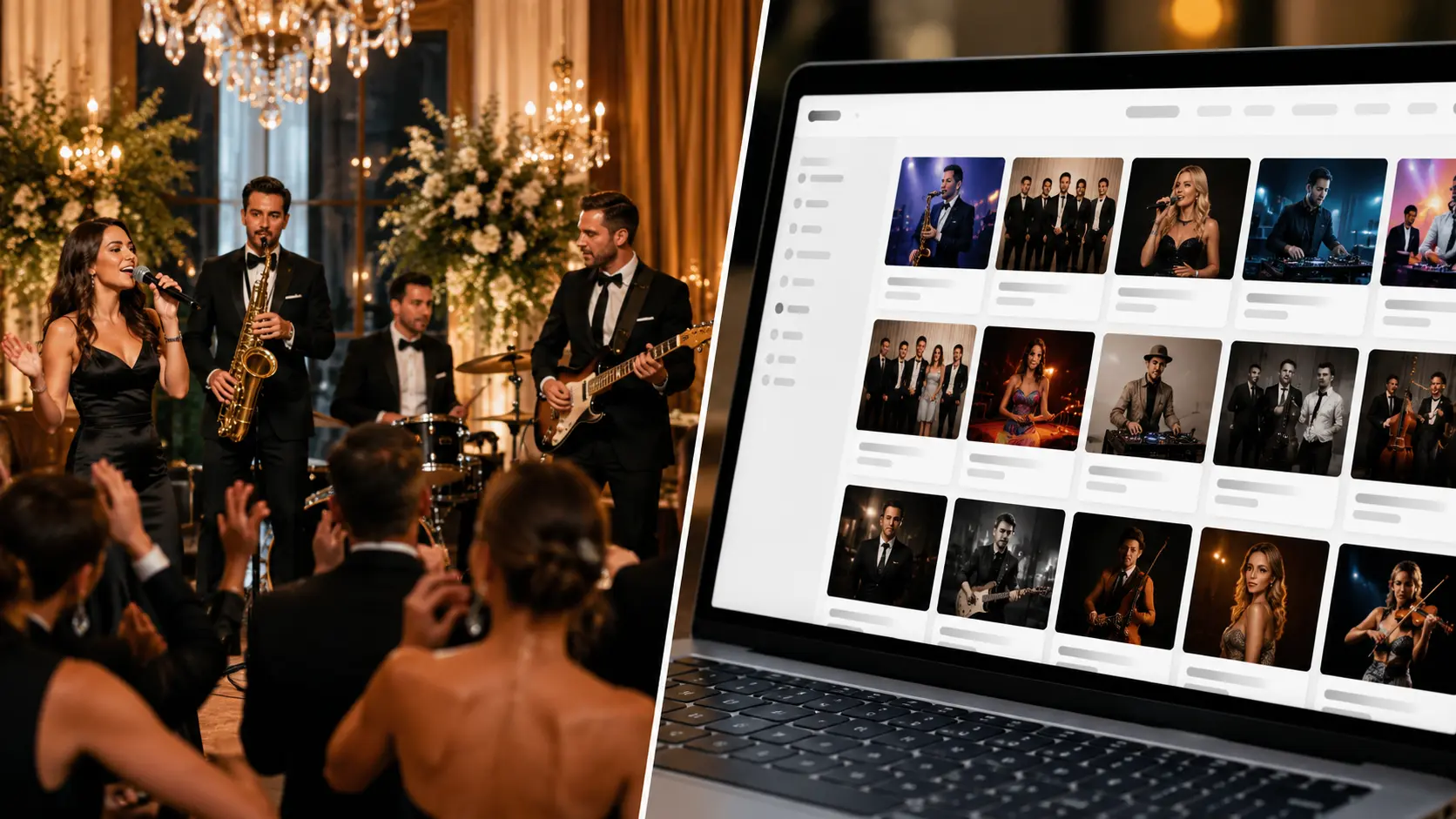
There are two broad models in the market. The first is a curated roster -- a company that maintains a deliberately sized group of vetted performers, knows each one personally, and matches them to events based on fit. The second is a high-volume directory -- agencies with dozens and dozens of performers across every category, where the roster is built for coverage rather than quality.
Both exist. Only one of them gives you reliable confidence in who shows up.
At St. Royal, we operate as a closed two-sided marketplace: artists come in through one side, clients through the other, and I run the middle. In an established market like Toronto, we run 7 to 8 A-level players deep in our most in-demand categories. In our more recently activated markets -- LA, Chicago, and Miami -- we keep the roster deliberately tighter, 2 to 3 artists per category, while we build. We don't expand headcount ahead of quality. The temptation to overbook is real in this industry -- I've seen it collapse companies, and I've felt it myself. We don't do it.
The vetting is personal. I've spent my career as a working musician, band leader, DJ, and at one point ran my own AV company. I've hired, performed alongside, and encountered thousands of artists across every role an event requires. That experience is what sits behind every addition to our roster -- it's not a form-based process, and it's not delegated. Artists come to us through two tracks: a formal submission and review process for those we don't yet know, and direct referrals from our existing A-tier talent for those who come recommended from within. Both tracks go through the same onboarding before anyone takes their first event with us.
One pattern worth being aware of in the broader market: there are entertainment companies operating under different names in different cities -- sometimes different countries -- that share the same website template, the same sizzle reel, and the same social content. The performers in the video may have no connection to the local act you'll actually receive. If you're doing due diligence, search for the company's name alongside other markets and see whether similar-looking brands appear. You're not looking for a red flag necessarily -- you're looking for clarity on what you're actually booking.
Ask directly: who will be at my event, by name or by specific role, and can I see recent footage of that performer or ensemble?
Every entertainment company should have a clear answer to this. If the answer is vague, that's the signal.
A professional agency maintains relationships with substitute performers across every category they offer -- not as a theoretical backup, but as an active network they can activate under real pressure. We have never missed a performance. Not once. We had a situation earlier this year where a cocktail pianist for one of our most important clients had a family emergency the morning of the event -- the team and all the AV were already hours away at the venue. We found a substitute, briefed him, had him in position and in wardrobe before the first guests arrived. No one at the event knew anything had changed. That outcome is only possible because the relationships exist before you need them.
It's also worth understanding why professional agencies build their contracts to allow for substitutions in the first place. Life happens -- illness, family emergencies, genuine personal circumstances -- and a performer who is mentally or physically not in a position to perform will deliver a worse outcome than an excellent, well-briefed substitute. Our contracts with our artists account for this reality. The goal in every case is the same: deliver the calibre and quality the client was promised. We have never failed to do that.
Ask specifically: what is your backup process, who are the substitutes, and how are they vetted relative to the original performer?

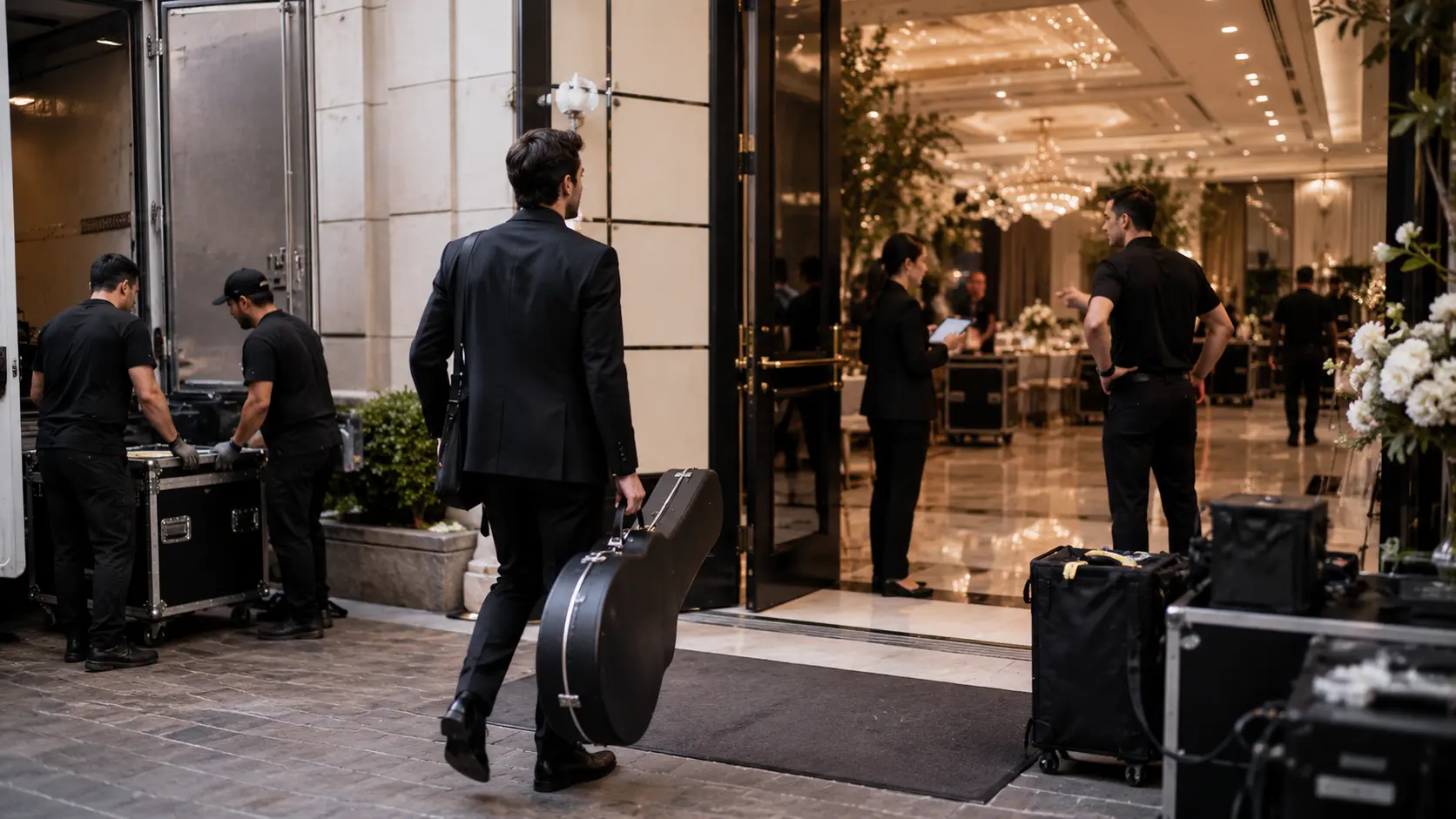
A professional entertainment company takes ownership of this coordination well before the event. Our production process activates roughly 60 days out. By the time we're two weeks from your event, AV coordination with the venue is already confirmed -- equipment lists, load-in logistics, power access, on-site contacts, noise restrictions. Five days out, every artist and the AV team has a draft call sheet in hand. Two days out, the final version goes out with any changes flagged. By the time load-in day arrives, there are no open questions.
Our process is also designed so that clients don't need to be involved in every operational detail. We work directly with the venue and planner to resolve the logistics. Clients are brought in only when a decision is material -- a meaningful change to the schedule, a room setup that affects the performance, something that genuinely warrants their input. The day itself should feel seamless. That's the point of having a professional team managing it.
Ask your entertainment vendor: what does your pre-event coordination process look like specifically, and how far out does it begin?
Not necessarily -- and a good entertainment company will explain why.
Special moments get precision: the first dance, the processional, the parent dances. Those are non-negotiable, and any professional team treats them that way. Our music planning process starts 45 days out, with a structured form that captures every key moment and the client's broader musical preferences. That's followed by a producer call at the 30-day mark where we build the event timeline together.
But for the dance floor, over-prescribing works against you. A DJ or band locked into a rigid must-play list loses the ability to respond to what's actually happening in the room. The energy at 10pm is not the same as it was at 7pm, and no playlist built weeks in advance can fully account for that. Our artists are experienced at reading a room and adapting in real time. That flexibility is a significant part of what makes the night work.
If a client wants a tightly prescribed set list, we'll deliver it. Most clients, once they understand how this works, prefer to give us the anchors and let us handle the rest.
Ask your entertainment vendor: what is your music planning process, and how do you balance client input with the artist's ability to read the room?
The most useful frame for evaluating entertainment pricing is to think of it as a skilled-labour engagement. The primary cost drivers are the number of people on site and the amount of time they're there, including both standby and performance time. The quoted package should tell you exactly what that covers.
What changes the number is a meaningful change to scope: additional performers added, a ceremony set not in the original agreement, or an event that runs significantly beyond the contracted time. It's more cost-effective to plan for what you actually need than to build short and rely on an overtime clause -- overtime rates are higher than standard rates by design.
On overtime specifically: at the reception, it's rarer than most couples expect. Most venues today enforce hard end times, which means the more common scenario is the event running behind rather than over. The real overtime risk is at the ceremony. Ceremony musicians are often committed to multiple events in a day, and a late ceremony start creates a cascade. Our standard grace period is 30 minutes -- beyond that, additional time will incur charges. Starting on time is the most effective way to avoid it.
For corporate events, there's more flexibility -- overtime can often be pre-agreed in advance so the decision is made calmly, before anyone is under pressure.
Ask your entertainment vendor: what is included in the package, what scenarios generate additional charges, and what is the overtime policy for ceremony musicians specifically?
Venue familiarity is genuinely useful -- faster load-in, established relationships with the on-site team, fewer unknowns. But for a professional entertainment company, an unfamiliar venue is standard operating procedure, not a risk.
We've been operating in Toronto for 15 years. In our LA, Chicago, and Miami markets, the majority of our events are at venues we're still building history with -- and our production process is designed for exactly that. Every new venue goes through the same pre-event contact sequence: floor plans, load-in logistics, parking, power access, noise curfews, on-site staff contacts. That information goes into our system and stays there. What might be a genuine gap for a solo performer is just process for a company built to operate at scale.
Ask less "have you been here before" and more "what does your pre-event preparation look like for a venue you haven't worked?"

We work alongside planners on every event we do. These are the questions I'd ask if I were sitting where you are.
Some do -- and it isn't always disclosed. A planner who receives a referral fee from a vendor they're recommending to you has a financial interest in that recommendation. The ethical standard, codified by bodies like WPIC, is disclosure. Ask directly: do you receive referral fees or commissions from any vendors on your recommended list, and if so, which ones?
Not deeply, but enough -- or they need to be working closely with someone who does. Many excellent planners come from a design background, and that's genuinely valuable. But production decisions -- AV, power, load-in logistics, stage setup -- require a different skill set. A design-focused planner who makes production calls without a trusted entertainment or AV partner in place is a real operational risk. Ask how they typically work with entertainment vendors, and who handles production decisions on the day.
This is one of the harder things to assess in advance, and one of the most important. Some planners are calm and decisive under pressure. Others become difficult at exactly the moment everyone needs to be pulling in the same direction. Ask them to walk you through a situation where something went wrong and how they handled it -- and consider asking other vendors, not just past clients, for a reference.
Look specifically at what happens if your planner becomes unavailable. Illness, emergencies, and at smaller firms, business closures do occur. The contract should name a succession plan -- who steps in, under what terms, and what your recourse is if no equivalent replacement can be provided.
Venue contracts set the terms that everything else has to work within. These are the questions worth getting answered before you sign.
Mandatory and advisory preferred lists are meaningfully different, and venues don't always volunteer which is which. If the list is mandatory, you can't comparison shop -- and it's worth asking whether the venue receives compensation from the vendors on that list. A mandatory list combined with undisclosed financial arrangements is worth understanding clearly before you commit. If the list is advisory, you have full flexibility.
Venue AV costs are one of the most common budget surprises in wedding planning. Some venues include capable in-house AV in the rental. Others charge plug-in fees or landmark fees for any outside vendor who connects to their infrastructure, on top of whatever the outside vendor charges. Ask what's included, what the outside vendor fees are, whether there's an exclusive AV arrangement, and what the power capacity is for a live entertainment setup. Older or heritage venues in particular can have electrical infrastructure that wasn't built for a full live production. [Post 1 of this series covers wedding AV costs in detail -- link when live.]
Every venue has them, and most couples find out later than they should. Get the noise policy in writing -- including any distinction between live music and recorded music -- and confirm the hard event end time and what happens if the event runs over.
The most consistent signal is evasiveness -- a vendor who can't or won't answer direct questions about who will be at your event, what their backup plan looks like, or whether they have financial relationships with other vendors you're considering.
Responsiveness during the sales process is also telling. A vendor who is slow to respond before you've signed is showing you how they'll operate once you have.
Worth noting: responsiveness works in both directions. The vendor relationships that function best are ones where both sides are clear on expectations from the start. Staying on the timelines your vendors provide, responding to planning documents when they're sent, and flagging concerns early makes it easier for your team to do their job well.
The vendors worth booking are the ones who welcome your questions, answer them specifically, and show you -- through their process, their contracts, and their communication -- that they've thought carefully about what can go wrong and built systems around it.
We've been delivering live entertainment at weddings and corporate events across Canada and the United States since 2011. The questions in this post aren't hypothetical -- they're the ones we've seen matter most across thousands of events, on both sides of the vendor relationship.
We started this series because transparency about how this industry works is something we take seriously. If you have questions about what a specific entertainment package should include, how to evaluate a quote you've received, or what to expect from a professional entertainment company, we're happy to talk it through.
---
- Why does wedding AV cost so much — and what are you actually paying for?
- What does "preferred vendor" actually mean at a wedding venue?
- Wedding kickbacks explained: planners, venues, and the referral fees most couples don't know about — coming soon

Andrew St. Royal is the founder and creative director of St. Royal Entertainment. A former professional musician, Andrew has been instrumental in thousands of events, bringing his expertise as a musician, band leader, agent, music designer, and event producer to every experience. His deep understanding of live entertainment and event production allows him to create unforgettable, strategically curated music programs for high-end venues and luxury events.
Ask about their process if your assigned performer becomes unavailable, what your cancellation rights look like on both sides, and whether anyone on your vendor team has an undisclosed financial relationship with the others. Most couples skip these questions — and many entertainment companies are counting on that.
The clearest red flag is evasiveness — a vendor who won't give direct answers about their backup process, how they handle staffing changes, or whether they have financial relationships with other vendors on your list. Slow responsiveness before you've signed is also a preview of how they'll communicate once you have.
Some do, and it isn't always disclosed. A planner earning a referral fee from a vendor they're recommending has a financial interest in that recommendation. The ethical standard — codified by bodies like ABC & WPIC — is disclosure, so it's worth asking directly whether your planner receives fees or commissions from anyone on their recommended list.