
Wedding AV costs more than most couples expect — and the line on the quote is rarely self-explanatory. "Audio/visual services" can mean anything from a single wireless microphone for the officiant to a full production setup with line arrays, theatrical lighting, and a team of technicians. Other times the line items read like a foreign language — model numbers, quantities, pro audio brand names you have never heard of, even if you consider yourself an audiophile. Understanding what you are actually paying for, and why venue AV in particular tends to be priced the way it is, can save you from sticker shock and help you make a smarter decision before you sign anything.
Here is the most important thing to know upfront: great AV is never noticed. If you are aware of the sound system during your wedding — if the music feels too bright up front, too muddy in the back, if a microphone hisses or a speaker pops — that is almost always a sign something has gone wrong. When AV is done right, your guests feel the bass on the dance floor, hear the band clearly from every corner of the room, and catch every word of every speech without straining. It feels like a controlled concert experience. The technology disappears and the moment takes over. That is what you are paying for.
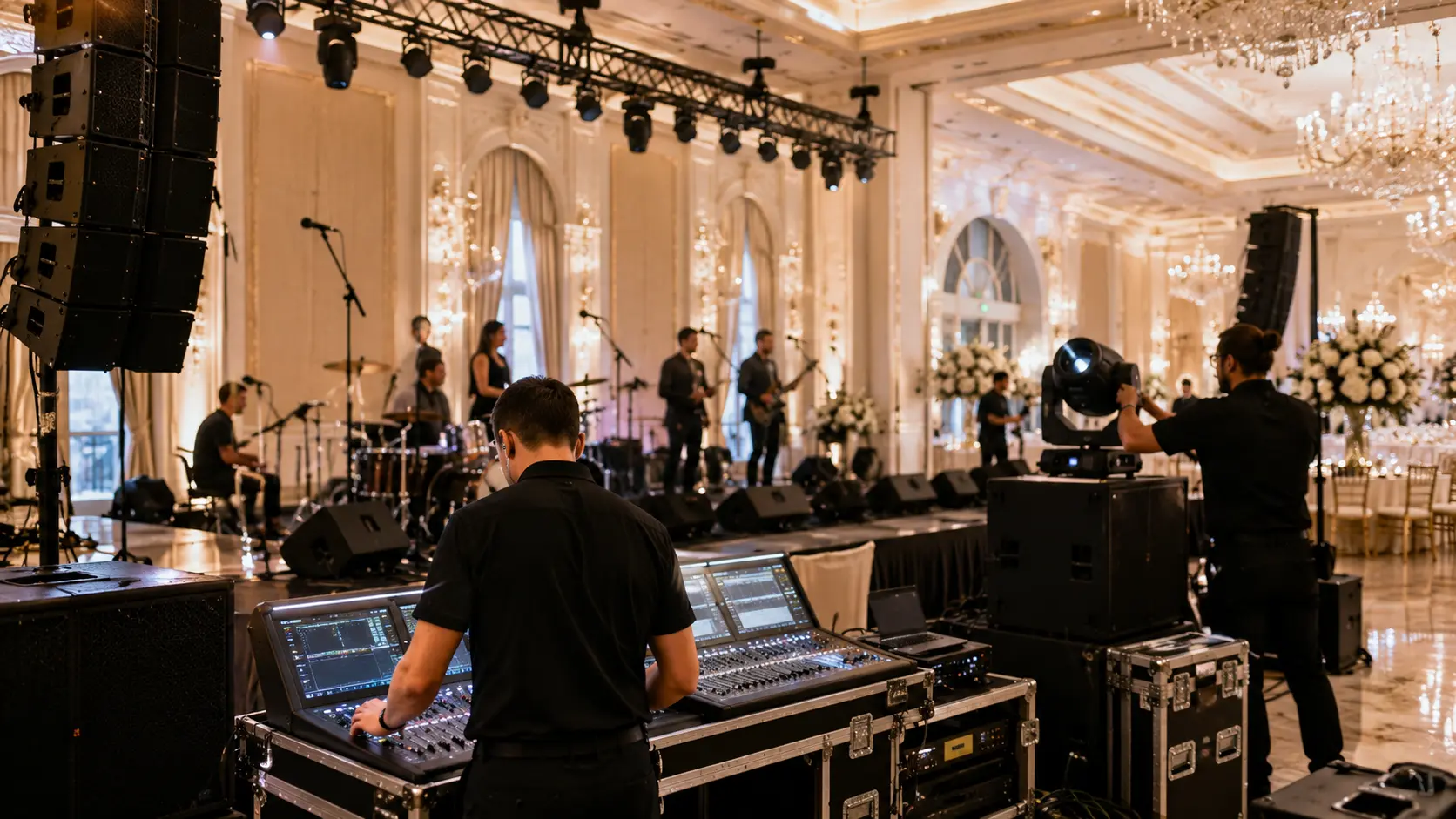
This is the backbone of your event audio. A professional sound system for a wedding includes main speakers positioned to cover the room evenly, subwoofers to deliver the low-end weight that makes music feel alive on a dance floor, a mixing console to balance every audio source in real time, and wireless microphones for speeches, toasts, officiants, and vocalists. For ceremony setups, it also means ensuring guests in the back row hear vows as clearly as those in the front row — something that is surprisingly easy to get wrong and almost impossible to fix once the moment has passed.
Done well, a sound system is invisible. The DJ's music fills the room with energy and clarity. The band's vocalist cuts through without distortion. Speeches land warmly in every corner. Done poorly, it becomes the thing your guests remember for the wrong reasons.
Lighting does more for a wedding atmosphere than most couples realise until they see the before-and-after. At the practical level it includes coverage for the dance floor, ambient uplighting around the room to shift the colour and warmth of the space, and focused lighting on key moments — the head table, the cake, the first dance. At the production level it can include dynamic stage lighting that responds to the energy of a live performance, moving fixtures that add drama to key moments, or architectural gobo projections that add texture and dimension to walls and ceilings.
The difference between static room lighting and a thoughtfully designed lighting plan is significant — not in a flashy, nightclub sense, but in the way a well-lit room feels warmer, more intimate, and more intentional. Lighting is often the AV component couples budget least for and notice most in their photos.
This is the component most couples underestimate, and it is often the largest single line item in a professional AV quote. Technical labour covers the people who make everything work: the audio engineer managing the live mix in real time, the lighting operator running the board during key moments, and the stagehands who handle the physical work of a production.
For a mid-sized wedding, a typical AV crew might be two to four people. For larger productions — a full live band with a stage, tiered lighting rigs, and multiple audio zones across a venue — a crew of eight to twelve is not unusual, and load-in can begin the day before the event. Equipment needs to arrive first, before décor, florals, and other vendors, so it can be positioned, rigged, and tested properly. A full band production setup can take four to eight hours. At the end of the night, everything is struck, packed, loaded back onto the truck, driven to a warehouse, and re-stocked in its place. Professional AV warehouses are large, climate-controlled operations that represent significant fixed overhead — and that overhead is reflected in every quote.
When you have a live band, the AV requirements increase substantially — and this is where the difference between a DJ event and a band event becomes most apparent.
A DJ requires a relatively straightforward setup: a left and right audio feed from the DJ's controller into the main system, plus whatever lighting is in the plan. A live band is a different proposition entirely. Each musician needs to hear themselves and the rest of the band through stage monitors or in-ear monitors, with a custom mix for each performer. The front-of-house engineer is simultaneously managing that stage mix and the mix the audience hears — two entirely separate audio environments running at the same time. A five-piece band is a genuine production. A ten-piece band with brass is a concert.
The other important distinction: the ceiling-mounted or wall-distributed speaker systems that work beautifully for DJ sound are often not appropriate for live band performances. A properly positioned front-of-house PA — speakers on stands or flown at the front of the stage — is required to create the immersive, directional sound that makes a live band feel like a live band rather than background music. This is a meaningful equipment and logistics difference, and it explains a large portion of why band AV costs more than DJ AV.
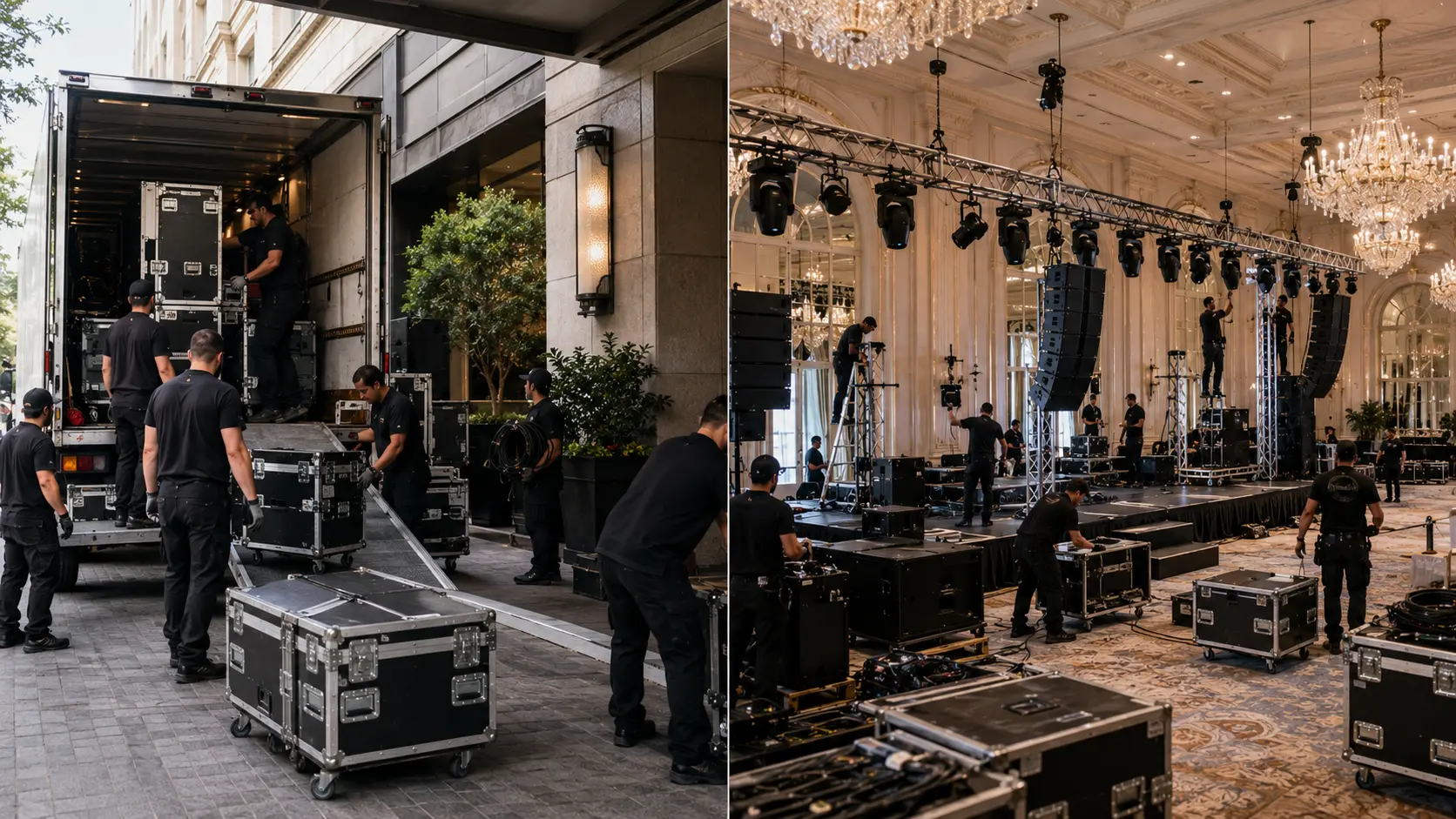
Professional audio equipment is expensive to purchase, expensive to maintain, and expensive to transport. A quality speaker system appropriately specified for a room serving 150 to 200 guests can represent tens of thousands of dollars in equipment — and that is before a lighting rig, mixing consoles, cabling, rigging hardware, road cases, and a vehicle capable of moving all of it.
At the higher end of the market, AV companies regularly deploy top-tier audio brands — d&b audiotechnik, L-Acoustics, Meyer Sound — systems that were previously the domain of touring concert productions and have become increasingly accessible to the premium wedding and event market. A full production rig from one of these manufacturers, properly deployed for a large wedding, can represent hundreds of thousands of dollars in equipment.
An experienced audio engineer who can set up a full band production, manage a complex live mix, and troubleshoot problems in real time on the most important day of your clients' lives is not an entry-level hire. Neither is the lighting director managing a dynamic show from a console. Their rates reflect years of training and a level of accountability that the moment demands.
Couples rarely see this part, but it is a substantial component of what they are paying for. A professional AV team for a medium-sized wedding event will spend three to six hours loading in, assembling, positioning, and testing equipment before the first guest arrives. For larger productions, load-in begins the day before. Equipment is typically the first thing into the venue and the last thing out.
At the end of the night, once the last guests have left, the crew strikes the entire production — disassembles every rig, packs every cable, case, and fixture, loads everything back onto the truck, and returns it to the warehouse to be inspected, cleaned, and restocked. Professional AV companies operate large warehouse facilities that add meaningful fixed costs to every job. That infrastructure is part of what you are paying for when you hire a reputable provider.
Reliability. Expertise. And the confidence that if something goes wrong, it gets fixed before your guests notice. Professional AV operators carry backup equipment and redundant systems precisely because failure is not an option. A microphone that cuts out during the father-of-the-bride speech is not an abstract inconvenience — it is a moment that does not come back. The premium for professional AV is, in large part, a premium for accountability.

In-house AV refers to either a permanently installed audio and visual system within the venue, or an exclusive AV partner that the venue works with on a contracted basis, bringing equipment from their own inventory for each event. We will discuss exclusive AV arrangements in more detail in a future post in this series — the distinction matters, and it is worth understanding before you book.
The case for in-house AV is real and legitimate in the right circumstances. A venue that has invested in a purpose-built sound system designed specifically for its room can deliver exceptional results, particularly for DJ-based events where a simple stereo feed into a well-designed installed system is often the cleanest and most reliable setup available. Venue-familiar AV teams also have an important practical advantage: they know the space's acoustic characteristics, its floor plans, and — critically — its volume and noise restrictions. Compliance with local bylaws and venue sound policies is something an experienced in-house team handles without drama.
Outside AV — hiring an independent AV company or entertainment provider who brings their own equipment — often makes more sense when the production requirements of your specific event exceed what the venue's in-house system is designed for.
This is most common with live bands. Live band sound is significantly more complex than DJ sound, and most in-house venue systems are not built for it. A band requires a dedicated front-of-house PA system positioned at the stage — ceiling-mounted or distributed speakers that work well for DJ coverage create a jarring, unfocused sound for live performance. Band musicians also require detailed stage monitor mixes, often via in-ear monitors, that need to be dialled in by an engineer who knows the group. An unfamiliar technician working with an unfamiliar system on an unfamiliar band is a recipe for a difficult night.
For this reason, it is most common for professional entertainment companies providing live bands to bring their own sound and technical team. Most venues accommodate this without issue — and many actually prefer it for band events, recognising that the technical complexity is best handled by people who work with those specific performers regularly.
Neither option is automatically superior. The honest advice is to ask specific questions rather than making assumptions — and to confirm whatever arrangement you land on in writing before the contract is signed.
Many venues charge a fee — sometimes called a landmark fee, a plug-in fee, or an outside vendor surcharge — when a couple chooses to use an AV provider other than the venue's preferred or in-house partner. This is worth understanding before you book your venue, not after.
Some of these fees reflect legitimate operational concerns: technical compatibility between outside equipment and installed systems, liability in case of equipment damage, and the logistical coordination of an additional vendor in a managed space. These are reasonable considerations and in many cases the fee reflects real administrative cost.
Some are commercial. Venues increasingly have formal arrangements with AV providers that include revenue sharing or exclusivity terms. When a couple brings in an outside AV company, the venue loses that revenue. The outside vendor fee is, in some cases, a mechanism to recapture it — or to make the in-house option look more attractive by comparison.
This does not make the fee inherently unreasonable. But it does mean you should understand what you are paying for before accepting it as a given. Ask your venue directly: what does the in-house AV include, who operates it, what specific equipment is in the system, and what is the process for bringing in an outside provider? A venue that cannot answer those questions clearly is telling you something worth knowing.
In most cases, yes — though the answer depends on the venue and the nature of your entertainment. The majority of venues with preferred or in-house AV options still permit outside providers, typically with an additional coordination or insurance requirement. Many venues, particularly those with extensive experience hosting live band events, accommodate outside AV and technical teams with no issue at all.
Venues with fully exclusive AV arrangements — where no outside equipment or provider is permitted under any circumstances — are less common, but they do exist and they are worth asking about explicitly before you sign a venue contract. More on how those arrangements work, and what they mean for couples, in a future post in this series.
When you book a live band through a professional entertainment company, the AV conversation is often already resolved. The band's technical rider and the entertainment company's production team handle sound and technical requirements as part of the package — which means the question of in-house vs outside AV may be simpler than you think, and many venues will simply permit it without additional fees when it is framed as part of an entertainment engagement rather than a separate AV vendor relationship.
This comes up more than you might expect — couples who are trying to reduce costs sometimes consider renting speakers, microphones, and basic equipment directly and either setting it up themselves or handing it off to their entertainment team to operate.
It is almost always a bad idea, and here is why.
Rental equipment is not the same as production equipment. Consumer and prosumer gear from rental houses is handled by many people, maintained inconsistently, and often returned with problems the next renter discovers mid-event. A speaker that cuts out, a microphone that crackles, a cable packed with a fault — these are not hypothetical risks, they are common ones. Unlike a professional AV company that tests every piece of gear before it leaves the warehouse and carries backups for everything, a rental house sends you what is on the shelf.
There is also a real skill component to making audio equipment work properly in a live event environment. Positioning speakers correctly for a room, setting gain structure so a microphone does not feed back, managing a mix in real time as the room fills with people and the acoustics shift — these are things experienced engineers do well because they have done them hundreds of times with gear they know intimately. Handing unfamiliar rented equipment to a team encountering it for the first time on the day of your wedding is a meaningful gamble.
And then there is the practical reality: someone has to pick up the equipment, transport it, set it up, operate it through the event, break it down, load it out, and return it to the rental house — often the morning after your wedding. The cost saving, when you factor in rental fees, transportation, your own time, and the very real risk of equipment issues, rarely pencils out the way it looks on paper.
Leave this one to the professionals. The peace of mind alone is worth it.
One AV-related cost that surprises many couples is the power drop. Older or heritage buildings in particular may have electrical infrastructure that was not designed for the combined power demands of a full wedding production — AV, catering equipment, professional lighting, and other vendors all drawing simultaneously can be enough to flip breakers and cause power interruptions.
A power drop is a heavy-duty power distribution solution, connected directly to the venue's electrical panel by a licensed electrician, that delivers a stable, dedicated source of power — typically across several circuits — to the main event space. Vendors plug directly into the power drop rather than competing for wall outlets. At venues where this is standard practice it may be included in the venue fee or charged separately; at venues where it is not, it may need to be arranged and quoted independently. It is worth asking about, particularly at events with significant production elements.
For a DJ-based wedding with ceremony and reception coverage in the Toronto market, a professional AV package typically runs between $1,500 and $4,500 depending on room size, lighting scope, and crew requirements. For live band productions, the range increases substantially — a basic band audio setup starts around $3,000, while a fully produced show with a tiered stage, premium audio, and a dynamic lighting design can reach $12,000 to $15,000 or more for the production component alone, separate from the band's performance fee.
Los Angeles sits at the higher end of the North American wedding market, and AV pricing reflects that. A DJ-focused AV package for a mid-sized wedding typically starts around $2,500 to $5,000, with premium setups running higher. Live band productions in LA — a market with high entertainment expectations and strong union labour influence in some venues — generally range from $5,000 to $20,000+ for production, with large-scale shows at luxury venues pushing well beyond that. Labour costs in LA are among the highest in the country.
Chicago is a strong live music market with a well-established event production industry. AV for a DJ wedding typically runs $2,000 to $4,500. Live band production costs are meaningful — industry sources cite Chicago wedding band costs averaging $4,000 to $15,000, with AV as a significant component of that figure at the higher end. Premium productions at iconic Chicago venues can run considerably more.
Miami's wedding market blends high-end resort venues with a strong Latin entertainment culture, and AV pricing reflects both. A professional DJ AV package typically runs $2,000 to $5,000 depending on scope and venue type. Live band productions vary widely — the market supports everything from intimate acoustic setups to full Latin orchestra productions with elaborate lighting. Expect $4,000 to $15,000+ for a well-produced live band AV package, with destination and resort venues often adding venue-specific fees on top.
Quotes that seem unusually low deserve scrutiny. Ask what specific equipment is being used, who is operating it, what their backup plan is if something fails, and whether the crew is experienced with live band events if that is relevant to your production. Some smaller ensembles and acoustic acts can manage their own basic AV and roll the cost into their performance fee — this is perfectly legitimate for the right scale of event, and worth discussing when you are comparing options.
Quotes that seem unusually high deserve line-by-line review. A reputable AV provider should be able to explain every component. If they cannot, or will not, that is useful information.
The goal is not the lowest price. The goal is confidence that your event sounds and feels the way it should — and the peace of mind that if something goes wrong, it will be handled before your guests ever know.
Remember: great AV is never noticed. Going too cheap is a risk that tends to make itself known at the worst possible moment.
We have been delivering live entertainment and production services at weddings and corporate events across Canada and the United States for over a decade. AV is part of almost everything we do — not as a standalone service, but as an integrated component of the entertainment experience we provide.
We do not warehouse AV equipment or operate as a standalone production company. What we do is coordinate the full technical requirements of the entertainment we deliver, which means our clients have a single point of contact for performance, sound, and event flow — rather than managing a band, a DJ, and a separate AV company as three independent relationships.
If you have questions about how AV works at a specific venue you are considering, what your entertainment package should include on the technical side, or how to evaluate a quote you have received, we are happy to talk it through. Transparency about how this industry works is something we take seriously — it is part of why we started this series.
---
Questions every couple should ask their wedding vendors before signing

Andrew St. Royal is the founder and creative director of St. Royal Entertainment. A former professional musician, Andrew has been instrumental in thousands of events, bringing his expertise as a musician, band leader, agent, music designer, and event producer to every experience. His deep understanding of live entertainment and event production allows him to create unforgettable, strategically curated music programs for high-end venues and luxury events.
AV pricing reflects equipment, skilled labour, and load-in/load-out as much as it reflects the performance itself — a single professional speaker system can represent tens of thousands of dollars, and an experienced audio engineer isn't an entry-level hire. Live bands increase costs further, since each musician needs a separate monitor mix on top of the audience mix. The premium is largely a premium for reliability and accountability, not markup for its own sake.
In-house AV is either a venue's built-in system or its contracted exclusive partner, and it's often a strong fit for DJ-based events. Outside AV — a provider bringing their own equipment — tends to make more sense for live bands, since most in-house systems aren't built for the stage monitoring and front-of-house setup a band requires. Neither option is automatically better; the right choice depends on what your event actually needs.
In most cases, yes — most venues that offer in-house or preferred AV still allow outside providers, sometimes with an added coordination or insurance requirement. Fully exclusive arrangements that block outside AV entirely exist but are less common. It's worth confirming a venue's specific policy before you sign.