
A wedding venue’s “preferred vendor list” usually means the venue has a group of suppliers it knows, recommends, or works with regularly. It does not automatically mean those vendors are mandatory, and it does not mean they are objectively better than companies that are not on the list.
That distinction matters because “preferred” can describe several very different things: a genuinely helpful recommendation, an approved-vendor policy, a commercial relationship, or—in some cases—a system that makes it increasingly difficult or expensive to use anyone else.
The question for couples is not simply, “Who does the venue prefer?” It is: what does that preference actually mean for my ability to choose the vendors I want?
Usually, no—but you should confirm that before signing the venue contract.
Some venues maintain a genuinely optional preferred list. They are essentially saying: these are companies we know, we trust them on our property, and you may want to consider them.

Others use an approved-vendor model. You can bring someone else, but the vendor may need to provide insurance, technical information, a signed venue agreement, or other documentation.
Then there are exclusive arrangements, where a particular category—often catering, AV, rentals, staffing, or occasionally entertainment—must be supplied by the venue or its partner.
Those are three different models, even though couples may hear the word “preferred” used loosely during the sales process.
Ask one direct question before you sign:
“Is this list optional, approved-only, or mandatory in any category?”
No. It usually means the venue has an established relationship with that vendor.
That relationship can be useful, but it is not a quality certification. A vendor can know a building well and still not be the best fit for your event. And a highly professional vendor can walk into a venue for the first time and execute perfectly.
At St. Royal, that is increasingly normal as we expand into new markets. Our producers contact the venue directly and confirm the current details for every event: load-in and arrival procedures, power, floor plans, weather contingencies, guest flow, sound restrictions, parking, load-out, and the right venue contacts.
We do much of that even at venues we already know because personnel, procedures, room layouts, and technical requirements change over time.
Current preparation matters more than historical familiarity. A vendor should not need to be on a venue’s list to be competent there.
The warning sign is not that the venue recommends someone. It is when “preferred” starts functioning like “required” without being clearly presented that way.
That can happen through direct exclusivity, but it can also happen more subtly.
A couple may technically be allowed to bring its own vendor, but discover that doing so triggers extra fees, unusual approval hurdles, restrictive technical rules, or a noticeably more difficult coordination process.
Some venue requirements are completely legitimate. Venues have every right to protect their property, installed systems, staff, and operating standards.
But the requirement should make sense when applied to a professional, reputable outside company.
“Unknown to us” is not, by itself, a technical reason for an outside vendor to cost more.
The useful test is simple: can the venue explain specifically what changes because you are bringing in the outside vendor?
If the answer is vague, hypothetical, or built around worst-case “horror stories” that a competent professional vendor is already equipped to prevent, challenge it.
There is a difference between protecting the venue from an actual operational risk and using theoretical risk to make an outside vendor unnecessarily difficult or expensive to hire.
A venue can set supplier rules for events on its property, so an exclusive entertainment arrangement may be enforceable if it is clearly part of the venue agreement.
But I would think carefully before accepting an entertainment provider simply because the venue wants you to use one.

Entertainment is unusually personal. Your DJ or band affects the music, pacing, energy, presentation, and a large part of what your guests actually experience.
If the venue wants you to use its entertainment company, ask:
That last question is particularly important.
If the venue’s own DJ or band and the outside DJ or band require essentially the same production, there should be a clear explanation for why one suddenly carries a substantial technical premium.
Being an outside company is not itself extra technical scope.
This matters particularly with larger entertainment providers where the company name may stay the same but the actual performer can vary significantly from event to event. If you are being required—or heavily pushed—to use a particular entertainment company, make sure you are actually choosing the act, not simply accepting whoever gets assigned.
A venue referral should make your decision easier. It should not replace your ability to choose.
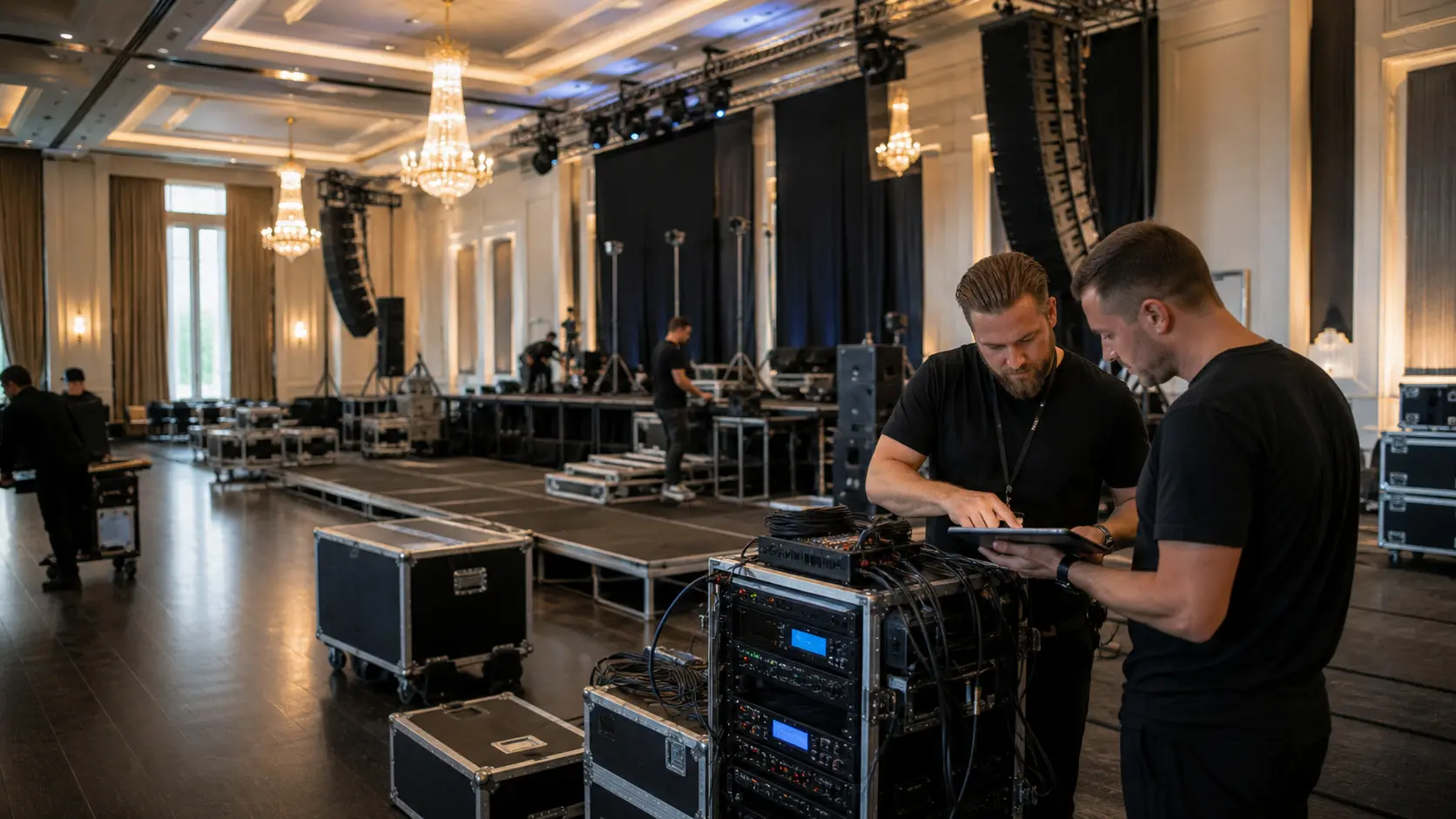
Ask what specifically creates the additional cost.
A professional entertainment company should be able to provide a technical rider explaining what the act requires. A professional AV provider should then be able to explain what equipment and labour are required to satisfy it.
The important comparison is like-for-like.
If the venue’s in-house band and your outside band have comparable technical requirements, there should not be a dramatic price difference simply because one company is “preferred” and the other is not.
If there is a difference, ask for it line by line.
If those questions have clear answers, the increased cost may be entirely reasonable.
If they do not, the fee may be commercial rather than technical.
That does not automatically make it illegitimate—but couples should understand what they are paying for.
This is especially important when a venue’s AV provider is also selling entertainment. The same company may control the technical environment while competing for the entertainment booking. That creates an obvious commercial incentive to make its own combined offering easier or less expensive than bringing in another entertainment company.
There can also be referral fees, commissions, revenue-sharing arrangements, or other financial incentives behind preferred and exclusive relationships. Those arrangements are not automatically wrong. If you are comfortable with them, that is your decision.
But they should not be disguised as technical necessity.
And when a clearly professional, insured, reputable outside vendor is being blocked altogether, it is reasonable to ask what legitimate operational problem the restriction is actually solving.
What exactly changed, and what exactly am I paying for?
Often, very simply: they work at the venue repeatedly, do good work, treat the staff well, and become someone the venue is comfortable recommending.
There can also be formal partnerships, referral arrangements, marketing agreements, commissions, or other commercial relationships behind a preferred list.
A commercial relationship does not mean the vendor is bad. Plenty of preferred vendors are excellent.
It does mean that “preferred” should not be interpreted as an independent certification of quality.
If it matters to you, it is reasonable to ask:
“Is this recommendation based solely on your experience with the vendor, or is there also a commercial relationship?”
We will get deeper into referral fees and commissions later in this series.

Before committing to a venue, I would want clear answers to these questions:
The best time to understand these rules is while you are still deciding whether to book the venue—not after the rest of your vendor team is already taking shape.
No.
Preferred vendor lists are normal, and in many cases they are genuinely helpful.
The red flag is opacity.
A venue saying, “These are the companies we recommend, but you are welcome to bring another professional vendor who meets our requirements,” is straightforward.
So is a venue saying, “Our catering and AV are exclusive, and that is part of our agreement.”
You may or may not like those policies, but at least you can make an informed decision.
The problem is when a recommendation is presented as optional and later becomes effectively mandatory through unexpected fees, manufactured technical obstacles, or rules that were not made clear before the contract was signed.
That is the distinction worth paying attention to.
We work with venues from both sides of this equation. Sometimes we are already well known to the property. Other times we are bringing entertainment into a venue for the first time.
Our approach is the same either way.
We contact the venue, confirm the current logistics and technical requirements, and make sure the entertainment plan works within the property’s real operating constraints. A venue does not need to know us already for that process to work, and we do not assume information from a previous event is still current.
Clear operating rules are rarely a problem. Artificial barriers are.
Couples should be able to choose the entertainment they genuinely want while giving the venue the information it needs to operate safely and professionally. Those two things are entirely compatible.
That is the standard I would look for when a venue tells you it has a preferred vendor list.

Andrew St. Royal is the founder and creative director of St. Royal Entertainment. A former professional musician, Andrew has been instrumental in thousands of events, bringing his expertise as a musician, band leader, agent, music designer, and event producer to every experience. His deep understanding of live entertainment and event production allows him to create unforgettable, strategically curated music programs for high-end venues and luxury events.
A landmark fee or outside vendor fee is a charge a venue applies when you hire a vendor outside its preferred or in-house network. Depending on the venue, it may also be called a commission fee, levy, surcharge, or plug-in fee. Always ask what the fee specifically covers before signing.
Usually, no. A preferred vendor list is often a recommendation, but some venues restrict certain categories to approved or exclusive vendors. Ask whether the list is optional, approved-only, or mandatory before booking.
The venue should be able to explain the additional cost clearly. If the outside DJ or band requires more equipment, labour, or setup, a higher fee may be justified. If the technical requirements are essentially the same, ask why the outside vendor costs more.

St. Royal is featured in the #2 Wedding in Toronto Life Magazine's most popular Real Weddings of 2023!
Party Band
DJ
AV Production
Jazz Band

Black tie, al fresco, and built for a full night of music.
Strings
DJ
Party Band
DJ & Sax
AV Production